The prevailing publication of the history of Cornwall’s largest tin smelting (blowing house).
A contemporaneous project to publish Calenick House’s rich history and development – very much work in progress during the various restoration phases.
19 January 2022Circa 1702 – Queen Anne (the last Stuart monarch) and Calenick House is but a humble cottage
The Newham Works opened (and was technically the first incarnation of Calenick, employing the first reverberatory furnace technology in Cornwall’s tin smelting industry).
Smelting houses were sited close to coinage towns (Truro, before 1838 when coinage was abolished), with access to estuaries or the coast allowing for efficient import of coal and bricks. They required a source of water-power (waterwheels) to run the stamps used to crush the slag for re-smelting.
Small ‘Calenick Crucibles‘ were manufactured in order to ‘assay’ or test the quantity of metal within the crushed ore. The crucibles resembled small china plant pots and were sold in nests like Russian dolls, exported as far as Australia and to other burgeoning tin mining economies.
Newham works is moved to Calenick circa 1712 where the house already exists – a cottage dating to 1702 with earlier parts – without the aggrandised façade visible today.
The move was likely owing to the sites easy access to Calenick Creek and plentiful supply of water power via a leat diverted from beyond Tolgarrick Farm to the West heading upstream of the River Tinney.
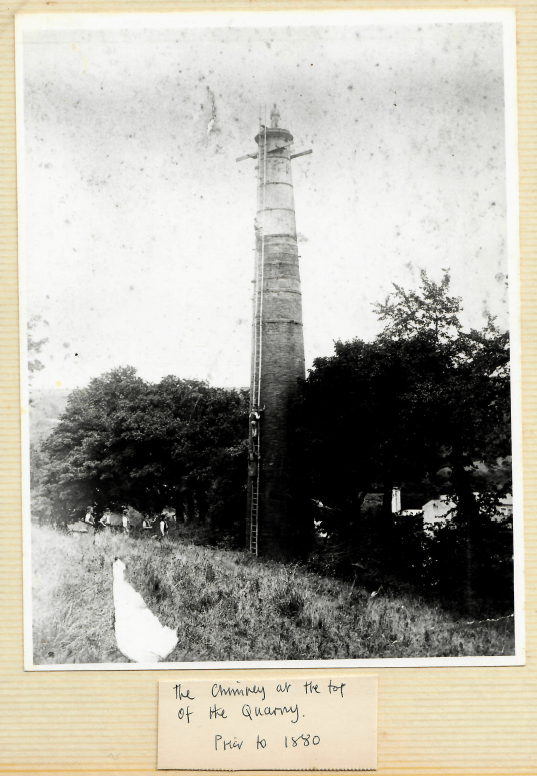
The site also allowed for the quarrying of a cliff face aloft which a tall chimney stack (flue) could be built in order to ventilate the ten furnaces that later existed.
Circa 1770 the house is aggrandised with a grand new façade – the slate hung with fine Georgian fenestration that you see today.
This was likely undertaken during ownership under Thomas Daniell who had succeeded William Lemon’s business interests c1760.
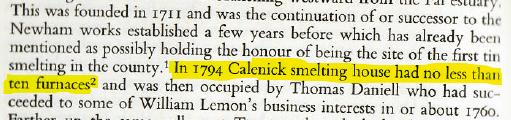
The chimney ‘stack’ was build aloft the quarried cliff face allowing for sufficient draught (draw) from the 10 furnaces into the air. It was likely demolished c1899.
‘X’ marks the spot where the remains of the chimney can be found today. There are very few photographs of the chimney, since most contemporaneous post card photographers deliberately cropped the industrial stack out of view to avoid any intrusion upon the ‘gentile’ façade.

-
Subscribe
Subscribed
Already have a WordPress.com account? Log in now.
 Calenick House